
SEARCA to highlight circular aquaculture innovations at IFS 2026
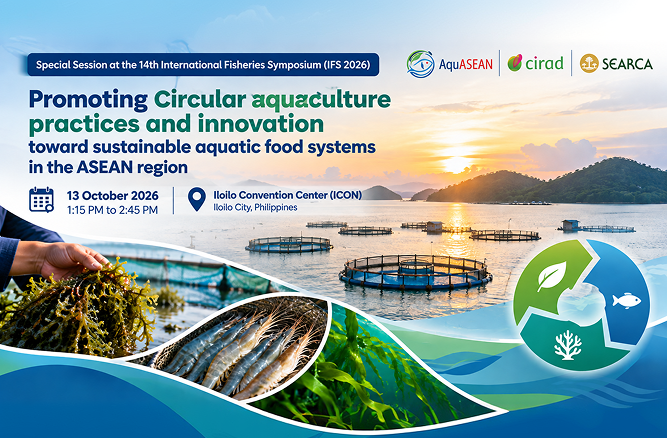
LOS BAÑOS, LAGUNA, Philippines — The Southeast Asian Regional Center for Graduate Study and Research in Agriculture (SEARCA), together with the French Agricultural Research Centre for International Development (CIRAD) and regional partners, will convene a special session on circular aquaculture during the 14th International Fisheries Symposium (IFS 2026) on October 13 at the Iloilo Convention Center in Iloilo City.
Held under the theme “One Blue ASEAN Fisheries for the Future,” the session, titled “Promoting Circular Aquaculture Practices and Innovation toward Sustainable Aquatic Food Systems in the ASEAN Region,” will bring together researchers, policymakers, development partners, industry representatives, and other stakeholders to exchange knowledge and experiences on sustainable aquaculture approaches in Southeast Asia.
The session will focus on how circular aquaculture can help address growing environmental and climate pressures affecting the region’s aquatic food systems. These include rising temperatures, changing hydrological conditions, extreme weather events, ecosystem degradation, resource constraints, and inefficient waste management, which can affect productivity, profitability, food security, and the livelihoods of small-scale producers and vulnerable communities.
Circular aquaculture promotes more resource-efficient production systems through approaches such as integrated production, nutrient recovery and reuse, waste valorization, nature-based solutions, and alternative feeds. The approach is aligned with the ASEAN Blue Economy Framework, which identifies sustainable aquaculture as a priority and emphasizes resource efficiency, innovation, knowledge exchange, capacity building, sustainable investment, and multi-stakeholder cooperation.
The session will also introduce the ASEAN Partnership for Sustainable Aquaculture (AquASEAN) Project, implemented by CIRAD together with SEARCA and other national and regional partners. AquASEAN generates scientific and socioeconomic evidence to support the transition toward climate-responsible and circular aquaculture in ASEAN. Its work covers waste reduction and nutrient recycling, biodiversity, climate adaptation, circular feed ingredients, socioeconomic benefits, business opportunities, capacity building, and policy needs.
Among the featured presentations are discussions on the ASEAN Blue Economy Framework and its priorities for aquaculture; the AquASEAN Project and its work on promoting circular aquaculture; an integrated shrimp–fish–seaweed production system in Thailand; the socioeconomic benefits of the 3R circular aquaculture model in the Lower Mekong Delta; and regulatory standards and institutional frameworks for integrated aquaculture production systems in the Philippines.
The program will feature experts from ASEAN and international research and development institutions, including the ASEAN Sectoral Working Group on Fisheries, CIRAD, the Asian Institute of Technology, Can Tho University, and the Department of Agriculture–Bureau of Agricultural Research.
A panel discussion on “Scaling Adoption of Circular Aquaculture Practices in ASEAN: Policy, Investment, and Partnership Imperatives” will follow the technical presentations. The discussion will examine the policy, investment, and partnership conditions needed to scale circular aquaculture practices across the region.
The session aims to identify policy implications, investment priorities, and opportunities for collaboration that can advance circular aquaculture and sustainable aquatic food systems in ASEAN. Its outputs will include a synthesis report and a policy brief containing key insights and recommendations, which will be disseminated through the AquASEAN Learning Hub and serve as inputs to a regional roadmap on sustainable aquaculture in ASEAN.